RESOURCED portfolios are available on limited basis in the Justseeds online store for an introductory price of $250. You may purchase one in the Justseeds online store and support this groundbreaking project, support the Justseeds Artists Cooperative, and invest in ongoing handmade portfolios.
Appeel is a virus spreading through interacting individuals, it demonstrates the basic principles of interactivity largely reliant on people’s behaviour. A surface is covered by a large number of coloured stickers, positioned in a grid. People can remove stickers, leaving white spots in the layout, as a result individually and collectively changing the walls appearance. These stickers then take on a life of their own, as they spread, extending beyond the installation itself, infiltrating private space and merging the boundaries of public and private space.
]]> ]]>
Coverage in the NYTimes here
]]> ]]>
]]>
]]>
As the World Cup draws to completion in South Africa, the social movements of the Poor People's Alliance continue to face off against the governing elite's escalation of harassment, displacement, repression and the violation of their human right to housing. Some of NESRI’s partners and allies (Chicago Anti-Eviction Campaign, Coalition of Immokalee Workers, Picture the Homeless, Poverty Initiative) who attended the recent U.S. Social Forum in Detroit rallied a solidarity soccer game, as a sign of solidarity with the South African grassroots, in particular the Abahlali baseMjondolo and the Western Cape Anti-Eviction Campaign who visited the United States in 2009. The poor of the US have found common cause and inspiration with the poor of South Africa in their creative struggles and visions for a better world. See photos from the solidarity soccer game. link
]]> ]]>Just a few miles from Nike’s global headquarters in Oregon last night, two Honduran workers revealed Nike’s family-destroying labor practices.
Gina Cano and Lowlee Urquía testified in front of members of the Portland Area Workers’ Rights Board and a crowd of more than 100 community members.
Jobs With Justice chapters conduct such Workers’ Rights Board inquiries across the country, inviting prominent members of the clergy and academy, along with business leaders and activists, to hear testimonies, issue reports, and create an open space to air local and international labor battles.
Both Cano and Urquía had worked in Nike-contracted factories in Honduras for many years before being laid off in January 2009 without notice and without legally mandated severance pay.
“We’re here in Oregon, the home of Nike, because we want to put a face to the consequences of Nike’s behavior,” Urquía said. “We’re saying to Nike that it is responsible every step of the way.”
The two women represented more than 1,700 workers who are owed $2.2 million in severance pay. The workers are also owed health care premiums, which were deducted from their wages but never paid to the health care system. This meant that workers could not access health care in the four months before the closure. At least one worker, who had been receiving cancer treatment, died because of this denial of care, according to Cano and Urquía.
]]> ]]>
After 5 years of stitching and 2 years of touring the Nike Blanket Petition is in full view at the Museum of Contemporary Craft (MoCC) in Portland, Oregon - 9 miles from Nike Headquarters. The CEO Mark Parker has been invited and has politely agreed to visit the museum before June 11 - the last day to see the swoosh. It will continue to show at MoCC during the exhibition Gestures of Resistance (through June 26); however, after June 11 it will be in the Study Center looking like Nana's afghan folded on her sofa. Museum admission is $3, $2 for students. Please contact me if you participated and intend to visit -- make it before June 11th!
Also on view is the work by: Sara Black And John Preus, Anthea Black, Carole Lung, Mung Lar Lam, Ehren Tool and Theaster Gates, curated by Shannon Stratton and Judith Leeman. A new installation called Fiber Alliance (images below) was created during my brief residency last week, cut short due to my 19th century pregnancy.


Setting up a process by which knitted cast-offs of American brands are unmade - unraveled and spun into new balls of yarn.

Pictured here is 3 Gap Inc. sweaters unraveled and recreated into knitted textiles. The motifs created on the knitting machine are made with the freeware knitPro, sampling patterns that have origin in the country where the labor was exported. In this case, the light & bright blue sweaters were made in Bangledesh and the new people pattern was sampled from a kantha. The chartreuse yarn was from an Old Navy sweater made in Thailand. The Thai pattern stitched in green traditionally means "Bird's Wings".

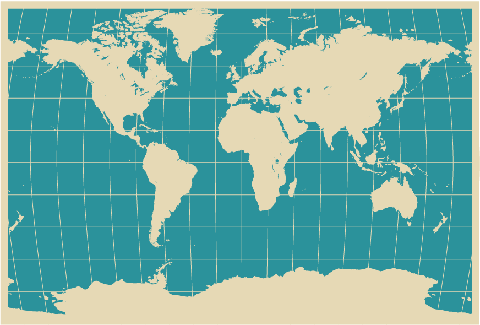
The unraveled yarn on the world map connects the brand headquarters to the country where the product was manufactured.
]]> ]]>

Photo credit: Kathryn Hetzner
San Jose Institute for Contemporary Art
560 South First Street
San Jose, CA
The Mill Series is a two channel video of animated woven swatches sourcing footage of American textile mills built during early industrial capitalism. It is up for one last week (Feb 6 - May 15) as an evening projection concurrent with the exhibition By A Thread. Read more here and here.
New prints on Just Seeds "Coal Will Never Be Clean" by Shaun Slifer
]]> ]]>
These pictures were taken in the New Bedford Massachusetts Whaling Museum, which has a very bizarre film from early last century on American Whaling. Also in the collection are these two artifacts (top) a woven "Whaler's Hat", 19th century, probably Nootka, made from spruce root and pigment. "Documented during the voyages of James Cook in the mid 18th century, these hats held special status significance to both the men and women of this whaling culture."

This is a swift (yarn winder) made from whale bone. The museum wall text says "From Pursuit to Preservation" but it's mostly bones, artifacts and amazing paintings from the history of Whaling.
]]> ]]>Playfair 2012 is co-ordinated by the TUC and Labour Behind the Label (the UK Clean Clothes Campaign) and involves unions and various campaigning organisations.
The coalition wants the organisers of the London Olympics to ensure that workers making sportswear for the 2012 Games won't be working in appalling and degrading conditions, and that all Olympic-branded goods will be ethically produced.
The campaign website http://www.playfair2012.org.uk/ sets out the standards the coalition expects from the London 2012 Games organisers, the International Olympic Committee (IOC) and sportswear brands, and explains how individuals can get involved in the campaign. There is also a resources section with reports and video clips.
Millions of people are employed in the global supply chains that produce kits for Olympic teams, and the sportswear and souvenirs available on our high streets. Evidence shows that the sportswear industry and Olympic movement have a poor track record on workers' rights, says the campaign. Playfair 2008 research published before the Beijing Games found workers employed by Adidas suppliers in China were making sports shoes that retail for upwards of £50 a pair for just £20 per month, and others working 80 hours a week stitching footballs. In another factory producing stationery, children as young as 12 years old were being forced to work 15 hours a day.
TUC General Secretary Brendan Barber said: "Delivering a legacy for London was at the heart of the Government's successful Olympic bid. And what better legacy than a commitment to end the exploitation and abuse involved in the sportswear and athletic footwear industries? We want London 2012 to raise the bar on workers' rights throughout Olympic supply chains."
]]> ]]>