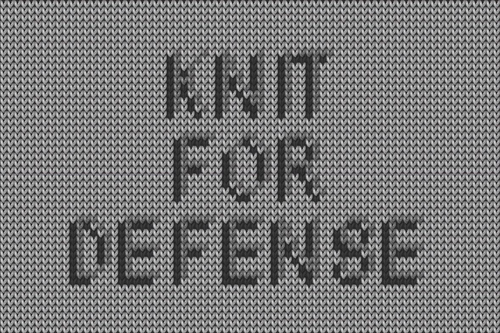
One-hundred-and-fourteen-days until Election Day! I have started to machine-knit to expedite Stitch for Senate helmets. A good many people have volunteered and we're on track to make it to 100. Right now we have 51% of the helmets, the newer ones being the Class II Senators (whose term is up, many seeking re-election) ...the posts have links to a few voting positions on Iraq and Veteran policies. I prefer the special uniqueness of the handknit but what can I say it's faster (2 hours vs. 3 days) and Election Day is closing in on us! IT IS NOT TOO LATE TO PARTICIPATE!! I would love your help. Final deadline is August 16, 2008 (In the mail not postmarked.)
]]> Here's 15 seconds of video of how slow my machine knitting is... consider one stroke as one row of knitting. My friend Liz got ear trouble from too much machine knitting - so I crocheted some earplugs with pink cotton yarn. Basically its a chain of 15 with long ends you can just tug out. Will supply machine knit pattern on demand.
Adama Kargbo was born and raised in Sierra Leone, but moved to New York when she was 12. After graduating from the famous fashion design program at Parsons, she returned to her home country, ravaged by a desperate and brutal civil war, to launch her high-end line. By Andrew Price Photos by Henry Jacobson
Read whole article on Good Magazine.
]]>
Robot 250, a city-wide program designed to celebrate the art and technology of robotics, developed in conjunction with Pittsburgh's 250th anniversary. Meet the visionaries behind the groundbreaking program that has enabled Pittsburghers of all ages to build their own customized robots. Meet representatives of the Robot 250 community, including students, professional artists, teachers, project directors, sponsors and funders of this unique event. Get a sneak preview of the Robot 250 Festival, featuring 11 gigantic robot installations that will be on display at major cultural locations around the city from July 11 - 27.
]]>U.S. states, cities, and counties are inadvertently using millions of taxpayer dollars to purchase goods from companies engaged in serious human rights and labor violations, according to a first-of-its-kind report released today by SweatFree Communities. The study, Subsidizing Sweatshops: How Our Tax Dollars Fund the Race to the Bottom, and What Cities and States Can Do, includes in-depth case studies of 12 factories in nine countries that produce public employee uniforms for nine major uniform brands.
Elected officials, religious leaders, human rights groups, students and labor unions today participated in at least eight rallies, press conferences or other events around the country. "We are calling on public entities to join the Sweatfree Consortium, a collaborative effort of states, local governments, labor rights experts, and human rights advocates to end tax dollar support for sweatshops," said Bjorn Claeson, Executive Director of SweatFree Communities and an author of the report. "We can use our collective purchasing power to improve working conditions instead of furthering the race to the bottom."
The Sweatfree Consortium will help states, cities, counties, local government agencies, and school districts to enforce their commitments to end public purchasing from sweatshops by investigating factories and creating a market for change.
Subsidizing Sweatshops reveals widespread human rights and labor violations throughout the uniform industry, including: child labor; illegally low poverty wages; forced and unpaid overtime; verbal, physical, and sexual abuse; pregnancy testing, excessively long work hours causing physical ailments; disregard for freedom of speech or association; and elaborate schemes to deceive corporate auditors.
Workers at a Williamson-Dickie Manufacturing Co. (Dickies) supplier factory in Karachi, Pakistan, described to researchers the excessive working hours to which they are subjected: "12 to 13 hours a day, 30 days per month," according to Fazad.
"If we refuse shifts, are absent, or make a mistake then our supervisors and other mid-level management beat and slap us," said Bithi, a 22-year-old sewing operator who has worked four years at a Bangladesh factory producing undergarments for Bob Barker Co., a major supplier for U.S. state and county correctional institutions.
"In a globalized apparel industry where these violations are widespread,... gathering information about problems is an important first step in our effort to ensure full respect for the rights of the workers that our policies are designed to help," wrote Betty Lamoreau, Director of Division of Purchases for the State of Maine, in letters to Cintas Corp., Blauer Manufacturing Co., and Bob Barker Co., three of the companies named in the report.
"We also expect you will take all appropriate steps to work with your suppliers to ensure that any labor rights and human rights violations are corrected and conditions for workers are improved," wrote Wisconsin Secretary of Administration Michael L. Morgan in letters to Williamson-Dickie Manufacturing Co., Fechheimer Brothers Co., Blauer, and Bob Barker. The other companies named in the report are Lion Apparel, Propper International, Rocky Brands, and Eagle Industries.
Subsidizing Sweatshops recognizes the cities, states, counties, and school districts that have pursued sweatfree purchasing policies and are working proactively to establish the Sweatfree Consortium.
"If more people were informed about what conditions are like for the workers who make their clothes, I think that our situation would be different and there wouldn’t be as many violations in the factories,” said Elisa, a 31-year-old seamstress making uniforms at the Calypso Apparel factory in Nicaragua. “We hope that people in other countries will continue to support us and that we can all progress together."
Subsidizing Sweatshops is available at: http://www.sweatfree.org/subsidizing
]]>
Hello from Scotland. This was taken in the last days on Shetland Island, sheep are everywhere! I'm now writing from Fair Isle Bird Observatory visiting for my research on the isle's infamous knitting technique. (More on this soon.) I'm also posting because I got an email from someone on my mailinglist who got SPAMed by a hack of my MAILINGLIST. If anyone else had this problem please mail me @ the query address. Another disturbing tech related issue was I got a google alert for my other site Stitch for Senate that mentioned Russell Feingold which led to a virus. Luckily it was stopped in time.
]]>Saturday, July 12, 11:00am-1:00pm
Broad Street Ministry, 315 S. Broad St., Philadelphia
11:00-12:30pm Worker Rights Board Hearing:
Sweatshops & State Purchasing Practices
Testimony by sweatshop workers and public employees who wear the uniforms they make.
12:30pm-1:00pm Sweatfree Rally
@ National Governors' Association Centennial Meeting
Gather at Broad Street Ministry
Urge all 50 governors to join the Sweatfree Consortium to stop tax dollar support for sweatshops.
Speakers at the events will include:
Carmencita "Chie" Abad, former sweatshop worker in U.S. territory of Saipan
Kalpona Akter, former child garment worker from Bangladesh
Dennis Brutus, human rights activist
Bishop Dwayne Royster, Pastor of the Living Water United Church of Christ, Philadelphia
...and many more!
The Philadelphia Workers' Rights Board is a project of the Philadelphia Area Jobs with Justice, a coalition of faith leaders, students, unions, and community members who fight for living wages, top-notch benefits, and respect on the job for people in Philadelphia.
SweatFree Communities is a national network that organizes to end sweatshop exploitation by inspiring responsible local purchasing and fostering solidarity between U.S. communities and workers worldwide.
This event is part of the National SweatFree Summit. Visit http://www.sweatfree.org/summit
]]> CARMENCITA "CHIE" ABAD speaks from personal experience about the hardships endured by millions of workers in sweatshops around the world. Chie spent six years as a garment worker on the Pacific island of Saipan, a U.S. territory. She endured wretched conditions, frequently working 14-hour shifts in order to meet arbitrary production quotas for her employer, the Sako Corporation, which made clothes for the Gap and other retailers. When she tried to organize a union, Chie was met by fierce resistance from management and eventually lost her job. She now lives in the U.S., and works with Global Exchange to educate consumers about the inhumane factory conditions occurring worldwide, including on U.S. soil. Chie was instrumental in forcing 26 major retailers to settle a lawsuit in September 2002 to improve conditions in Saipan. Her story is an inspiring example of how people can win if they stand up for their rights.KALPONA AKTER became a child garment worker when she was 11 years old. She worked in a Bangladeshi garment factory for eight years and struggled to form a worker union in her factory. Due to her organizing efforts, she was fired and blacklisted. Now, as the Director of Bangladesh Center for Worker Solidarity, she supports labor union organizing; helps workers strengthen their negotiating skills and make legal complaints; and investigates labor conditions in factories producing for institutions with sweatshop-free sourcing policies. Bangladesh Center for Worker Solidarity's research is respected domestically and internationally, enjoys the trust of garment workers, and has a track record of producing thorough and credible research in the apparel sector.
DENNIS BRUTUS is a lifelong human rights activist and poet. He is perhaps the best-known African poet writing in English, although his books were banned for many years in his home country South Africa. His tireless work against apartheid in South Africa got him arrested and shot in 1963. He was sentenced to an 18-month jail term with hard labor on Robben Island where he broke rocks with Nelson Mandela. He was sent into exile in 1966 and proceeded to lead the successful movement to have South Africa and Rhodesia (now Zimbabwe) banned from the Olympics and other international sporting events. Since then he has remained active in struggles for human and cultural rights, including co-founding the Pittsburgh Anti-Sweatshop Community Alliance in 2002, connecting international solidarity with workers to the philosophy of Black Consciousness. He is currently Professor Emeritus in the Department of Africana Studies at the University of Pittsburgh.
BISHOP ROYSTER has served in Pastoral ministry for the past 16 years in United Methodist Church, the Mennonite Church and the Baptist Church traditions, and is the founder of Living Water United Church of Christ. Bishop Royster is an advocate for preparing congregations for the ministry of availability. He is fond of saying that, "Ministry should not be limited to Sunday mornings." It is with this passion that Bishop Royster became involved with Jobs with Justice supporting workers across the Delaware Valley to let them know that the faith community will not sit by and allow injustice and oppression live in any form.
contact summit@sweatfree.org for more information.
]]>
]]>
This is next week June 21st noon-6pm, and I will be participating in the army. Here's the description from artist/designer Liz Collins:
On Saturday, June 21 in Providence, RI, artist, designer, and RISD professor Liz Collins will stage KNITTING NATION PHASE 4: PRIDE. The piece will be an homage to and reconstruction of the original rainbow pride flag. It will ascend the steps and hill at Waterplace Park over the course of 6 hours, engaging all who enter this picturesque public space in the center of Providence.
KNITTING NATION (KN) is an exploratory and multi-faceted art project, inaugurated in 2005 by Liz Collins, which combines performance, site specific installation, and collaboration with clothing and textile design and manufacturing, using manually-operated knitting machines. The project is a commentary on the interaction of humans and machines, global trade, fashion and iconography, and a celebration of machine knitting as a creative medium.
]]> The KNITTING NATION manifesto can be found at www.lizcollins.com The rainbow pride flag was originally designed and constructed by Gilbert Baker in San Francisco in 1978 to symbolize the diversity of the gay community, and has now become an internationally recognized icon of LGBTQ communities, politics and/or market-based identities. The first flag was made with 8 colors, with each color possessing symbolic meaning: * hot pink for sex,
* red for life,
* orange for healing,
* yellow for sun,
* green for serenity with nature,
* turquoise for art,
* indigo for harmony, and
* violet for spirit.
Hot pink and turquoise were eventually dropped from the flag, in order to streamline the manufacturing of it, and the original symbolic intent of the colors has fallen away. The KNITTING NATION event will bring attention to this important and controversial symbol, examining it and reflecting on it, in the midst of the Providence Pride Festival.
At the June 21 event, from noon-6pm, eight knitters in unique and brightly colored uniforms will be seated in a row at manually-operated knitting machines under a tent on the stage at Waterplace Park, each knitting a continuous length of fabric. The tent, decorated with flags, slogans, and other graphic and material elements pulled from and inspired by gay culture and politics, will protect the knitters from weather and assert the presence of the KN encampment.
The other seven uniformed knitters will hand-stitch the knit yardage together as it comes off the machines. Every half hour, the knitters and stitchers will rotate positions, and this activity will carry on over the course of the afternoon, until a large banner grows up the face of the hill. During this knitting and stitching frenzy, costumed orators will take turns reading replies from an international internet poll, circulated by the artist, that describes the project and asks the simple question: “how do you feel about the rainbow flag?”. In addition, the public will be invited to reply to the poll on the spot, open mike style, during the event.
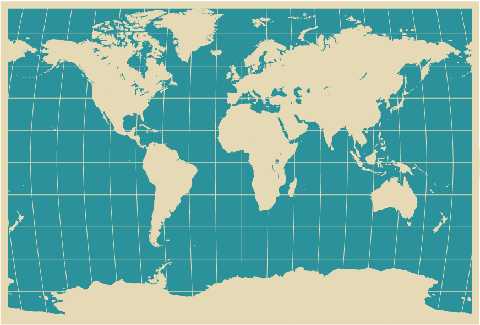
]]>Messed around with google map to document the Stitch for Senate helmets as they get made. I've only created a map for ones that have been mailed to me, not the ones still in progress.
= where participants were knitting helmets
= made at Stitch for Senate headquarters
We've just crossed the one-third of seats threshold and the goal is to get to 50% by the end of July. Participation in this pro-peace project is welcome. More information here!
]]>


More guerilla crafting at Knitted Landscape, Knitwit Netherlands and Radical Cross Stitch...


Yarn hand-spun from alpaca wool.

Downtown Cusco "Down with Privatization" ... the government is considering privatizing Inca ruins, obviously a devastating idea to everyone we talked to.

Machu Picchu

Yes, they sell sweaters on the train to Machu Picchu
]]>